


It’s one of the most common questions people quietly Google before booking a consultation. Will it look fake? Will people notice? Will I end up looking worse than before?
The fear is completely understandable. We’ve all seen the photos — strange-looking hairlines that sit too low, hair pointing in odd directions, obvious patches of density next to thinning areas. For decades, that’s what a hair transplant looked like, and the memory has stuck around long after the techniques themselves have changed.
Here’s the honest answer: a hair transplant today can look completely natural. So natural that even close friends won’t be able to tell. But that result isn’t automatic. It depends on a handful of decisions that most patients don’t even know they’re making. If you’re considering a hair transplant in Mumbai, here’s what you actually need to know — explained by Dr. Viral Desai, a celebrity hair transplant surgeon in Mumbai with over 20 years of experience.
Why Do People Think Hair Transplants Look Fake?
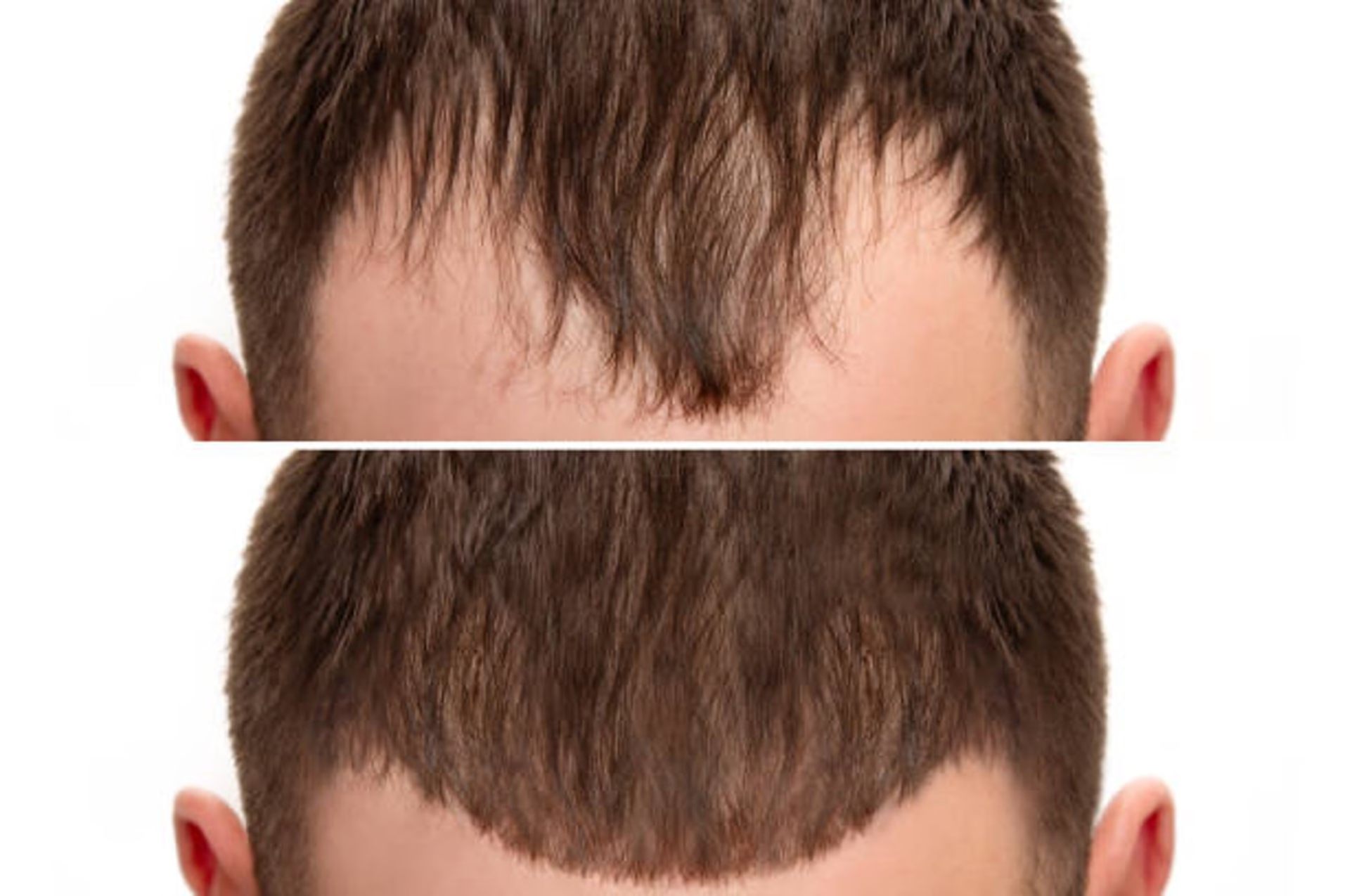
This reputation didn’t come from nowhere. There are real reasons people associate hair transplants with unnatural results, and most of them trace back to decisions made before the procedure even begins.
The biggest culprits:
- Old techniques. The hair plug transplants of the 1970s and 80s really did look fake. Large clumps of hair were transplanted at once, leaving doll-like patches that aged badly.
- Poorly designed hairlines. A straight, sharp, low-set hairline screams “transplant.” Natural hairlines are slightly uneven, irregular, and sit at a height that matches the person’s face.
- Incorrect graft angles. Hair grows at very specific angles depending on where it sits on the scalp. When grafts are placed at the wrong angle, the hair sticks out instead of lying down naturally.
- Wrong density. Too much density in the front with thinning at the crown looks artificial. Real hair gradually changes density across the scalp.
- Inexperienced surgeons. This is the underlying cause behind nearly all of the above. A skilled surgeon prevents these mistakes. An inexperienced one creates them.
- Visible scarring. Older surgical techniques sometimes left behind visible scars, especially in the donor area, which gave away the procedure.
Most modern bad results don’t come from technology — they come from skipped consultations, rushed planning, and surgeons who treat every patient with the same template.
Modern Hair Transplant Techniques That Give Natural Results
The good news is that today’s techniques are nothing like the plug procedures of the past. Done right, they produce results that genuinely cannot be detected from across the room — or even up close.
Here’s what’s actually used today at leading clinics like CPLSS:
- NHDT (Natural Hair Density Transplant)
This is the signature technique developed by Dr. Viral Desai. NHDT focuses on creating density that mimics natural hair distribution — fuller at the front, slightly lighter as it moves back, with carefully varied angles. It’s the kind of detail that decides whether your result looks transplanted or untouched.
2. FUE (Follicular Unit Extraction)
FUE hair transplant extracts individual follicular units — small natural groupings of 1 to 4 hairs — one at a time. There are no stitches, no linear scarring, and the results blend invisibly with your existing hair. It’s the most popular technique today for a reason.
- FUT (Follicular Unit Transplantation)
FUT hair transplant is still useful in specific cases, especially when a high graft count is needed in one session. With modern techniques, even the donor area scar is minimal and easy to hide.
- Sapphire blade and DHI refinements
Sapphire blades make smaller, more uniform incisions, while DHI (Direct Hair Implantation) allows for precise control of depth, angle, and direction. Both contribute to results that look more natural than anything possible just a decade ago.
These same precision techniques also apply to beard hair transplants and eyebrow transplants, where the margin for error is even smaller.
Hairline Design: The Biggest Factor in Natural-Looking Results

If you take one thing away from this article, let it be this: hairline design is what makes or breaks a hair transplant. You can have the best surgeon and the best technology, but if the hairline is designed badly, the result will look unnatural no matter what.
Designing a good hairline involves balancing many factors at once:
- A 25-year-old shouldn’t get the same hairline as a 55-year-old. A low, aggressive hairline on an older patient looks immediately wrong.
- Face shape and forehead size. The hairline should suit your facial proportions, not fight them.
- Natural irregularity. Real hairlines aren’t perfectly straight. They have subtle peaks, valleys, and randomness that a skilled surgeon recreates.
- Male and female hairlines are designed differently — and hair restoration for women follows a slightly different aesthetic protocol.
- Long-term planning. Your hair will continue to change with age. A great hairline still looks natural 10 to 15 years later.
To take the guesswork out of this, Dr. Viral Desai uses 3D hair transplant simulation so patients can preview their proposed hairline on their own face before the procedure. You see exactly what’s planned, you can give feedback, and you walk in knowing what to expect. No surprises, no regrets.
Before and After Hair Transplant: What Should You Expect?
A lot of patients expect to walk out of the clinic looking like a model in a shampoo ad. The reality is a bit more patient than that — but the journey itself is genuinely fascinating to watch.
Here’s roughly what the timeline looks like:
- Day 1 to 3: Mild redness and swelling. Small scabs form around each graft. You can return to work within a few days.
- Week 2 to 4: The transplanted hair sheds. This is called shock loss and is completely normal — though it does test most patients’ patience.
- Month 3 to 4: New growth starts to appear. Fine, soft hairs begin filling in.
- Month 6: Around 60 to 70% of the final result is visible. The hair thickens and starts looking more like your natural texture.
- Month 9 to 12: The full result settles in. Density, hairline, and texture all blend with your existing hair.
You can see the complete hair transplant results timeline for a month-by-month visual guide. Adding supportive treatments like PRP hair treatment, GFC hair treatment, or exosome therapy for hair loss during this period can accelerate growth and improve the final density.
By the one-year mark, most patients are looking at a head of hair that looks like they never lost it in the first place.
How to Avoid a Fake-Looking Hair Transplant
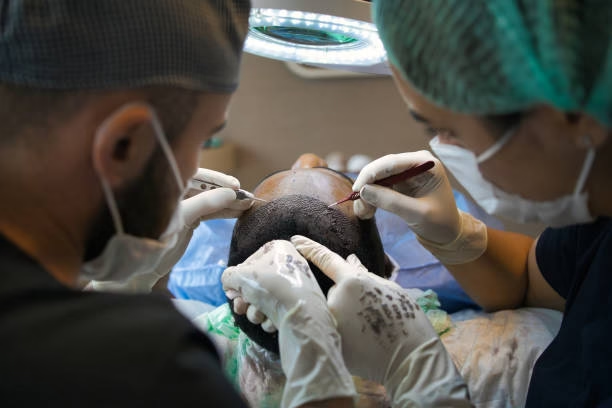
If you want a natural result, the decisions you make before the surgery matter more than anything else. Here’s what to do — and what to avoid.
Do:
- Choose a surgeon, not just a clinic. Find out who is actually performing your transplant. Many large chains use technicians for key parts of the procedure. Insist on a qualified, experienced hair transplant surgeon in Mumbai doing the work.
- Ask to see actual patient results. Real before-and-after photos from the surgeon’s own work tell you more than any brochure can.
- Insist on a detailed consultation. A good surgeon won’t promise you anything until they’ve examined your scalp, reviewed your medical history, and discussed your goals.
- Consider non-surgical alternatives where appropriate. If your hair loss is early-stage, treatments like mesotherapy for hair, laser therapy for hair loss, cyclical medicine for hair loss or Exosome for hair loss may be enough.
- Plan long-term. Your transplant should look good not just at month 12 but at year 10. A good surgeon thinks that far ahead.
Don’t:
- Don’t chase the cheapest price. A poorly done transplant costs more in the long run, both financially and emotionally.
- Don’t accept aggressive low hairlines. If a clinic offers to lower your hairline dramatically, walk away. You’ll regret it in your 40s.
- Don’t be rushed into surgery. Take your time. Get a second opinion if you need to. This is a decision you’ll live with for life.
For patients who want to add density without surgery — or in combination with it — options like scalp micropigmentation can also produce remarkably natural-looking results when done well.
Conclusion
So, do hair transplants look fake? Some of them do — and you’ve probably seen them. But those results come from a specific set of bad decisions, not from the procedure itself. With modern techniques, careful hairline design, and the right surgeon, a hair transplant today is virtually undetectable. Patients walk out of clinics looking like they never had hair loss to begin with.
The single most important decision you’ll make is who performs your surgery. Experience, ethics, technique, and aesthetic judgement matter more than any specific tool or method. Dr. Viral Desai, a leading celebrity hair transplant surgeon in Mumbai, has spent two decades helping patients get results so natural that they regularly hear, “Wait, you had a transplant?”
Choose wisely, ask the right questions, and you won’t have to worry about looking fake. You’ll just look like yourself — with hair.