

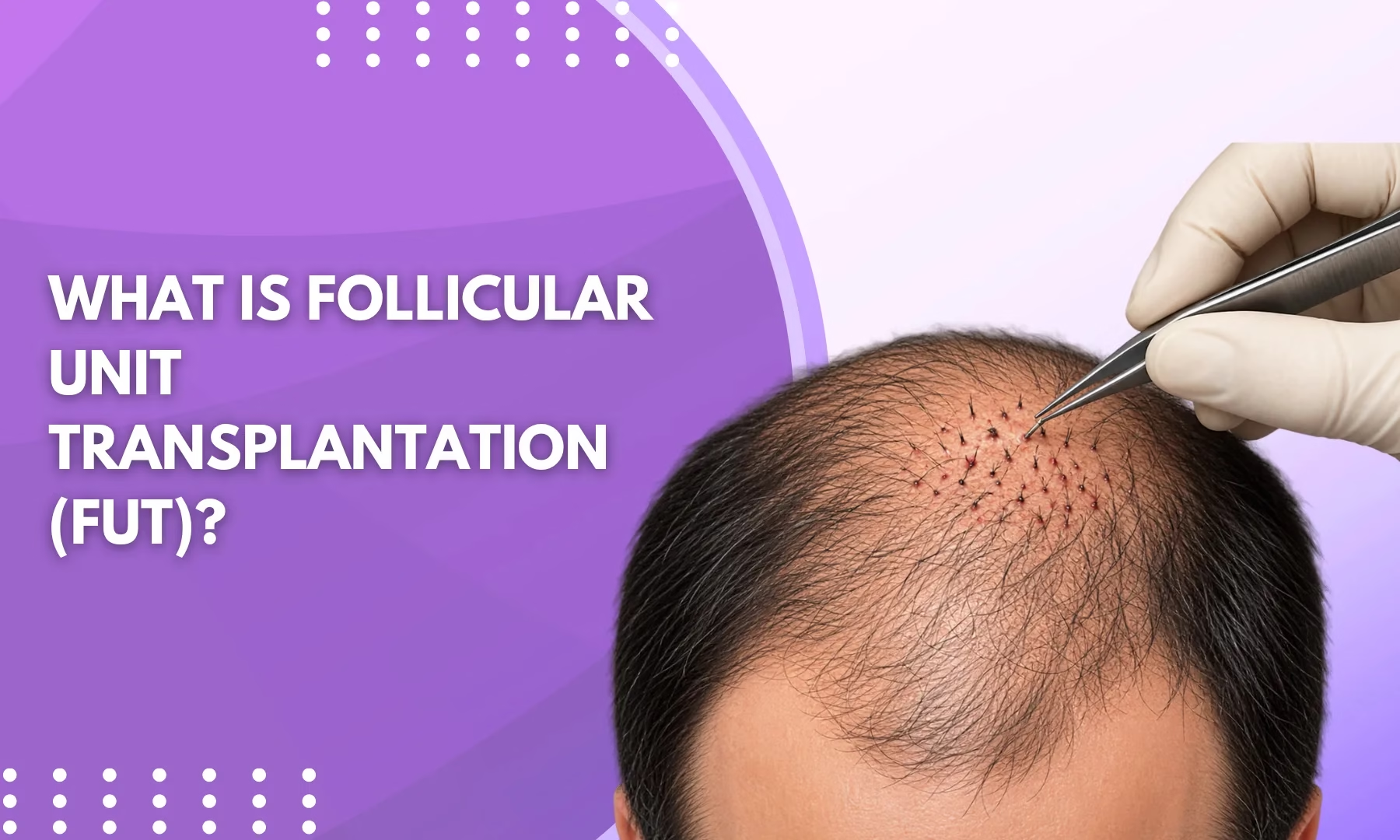
FUT, also called strip surgery or FUSS, removes a thin strip of scalp tissue from the back of the head, dissects it into individual follicular units under a microscope, and transplants them into balding areas. It’s one of two dominant hair transplant methods still practiced today, alongside FUE. Follicular unit transplantation has been refined for decades, and it still holds up in specific cases.
According to Dr. Viral Desai, fut hair transplant surgeon in Mumbai, “FUT gets written off too quickly, as though FUE made it obsolete overnight. That’s not quite fair. Dissecting under a microscope gives excellent control over each graft, and for patients needing a high graft count in one sitting, FUT still holds real clinical value.”
Curious whether FUT could be the right technique for your case?
How Does the FUT Procedure Actually Work?
The technique follows a distinct sequence, built around the strip harvesting step that defines it.
Strip harvesting: A thin strip of scalp, usually from the back of the head where hair loss resistance runs highest, gets surgically excised under local anesthesia.
Donor site closure: The donor incision is closed with sutures, leaving a linear scar that’s typically hidden by surrounding hair once healed.
Microscopic dissection: Technicians dissect the strip under high-powered microscopes into individual follicular units, a process that allows for precise, low-transection graft separation.
Graft implantation: The dissected units go into recipient sites in the thinning or balding area, following the same placement principles used in FUE.
A fut hair transplant consultation is where donor scalp laxity, graft count needs, and scarring concerns get weighed to see if FUT actually fits your case.
When Does FUT Still Make Sense Over FUE?
FUT hasn’t disappeared for good reason. Certain situations still favor it clinically.
High graft counts in one session: FUT can often yield a large number of grafts efficiently in a single sitting, which matters for patients with extensive hair loss.
Lower transection risk: Because dissection happens under direct microscopic visualization, FUT tends to reduce follicle transection compared to the blind extraction involved in FUE.
Limited donor density for FUE: Some patients whose donor areas aren’t well suited to individual extraction remain good candidates for strip harvesting instead.
Hybrid approaches exist too: Surgeons sometimes combine FUT and FUE across sessions, or within a single one, to maximize graft yield where donor supply runs tight.
Our detailed look at understanding hair transplant techniques covers FUE in full. It’s useful if you’re weighing both options side by side.
Why Choose Dr. Viral Desai for FUT Hair Transplant?
Dr. Viral Desai brings over 20 years of experience in hair restoration, with more than 10,000 successful hair transplant procedures performed across FUT, FUE, and other techniques.
Technique recommendations here are grounded in donor characteristics and graft needs, not a blanket preference for whichever method happens to be trending. Call +91 98338 77001 to book your consultation.
Wondering whether FUT fits your donor area and goals?
Frequently Asked Questions
Does FUT leave a visible scar?
Yes, a linear scar forms, but it’s usually concealed by surrounding hair.
Is FUT better than FUE for large hair loss areas?
It can be, since FUT often yields high graft counts in one session.
Does FUT hurt more than FUE?
Recovery involves more discomfort initially due to the surgical incision.
Can FUT and FUE be combined?
Yes, some surgeons use both across sessions to maximize graft yield.
Disclaimer: This blog is for educational purposes only. Suitability for FUT depends on individual scalp and donor characteristics, so an in-person evaluation is necessary before undergoing the procedure.