
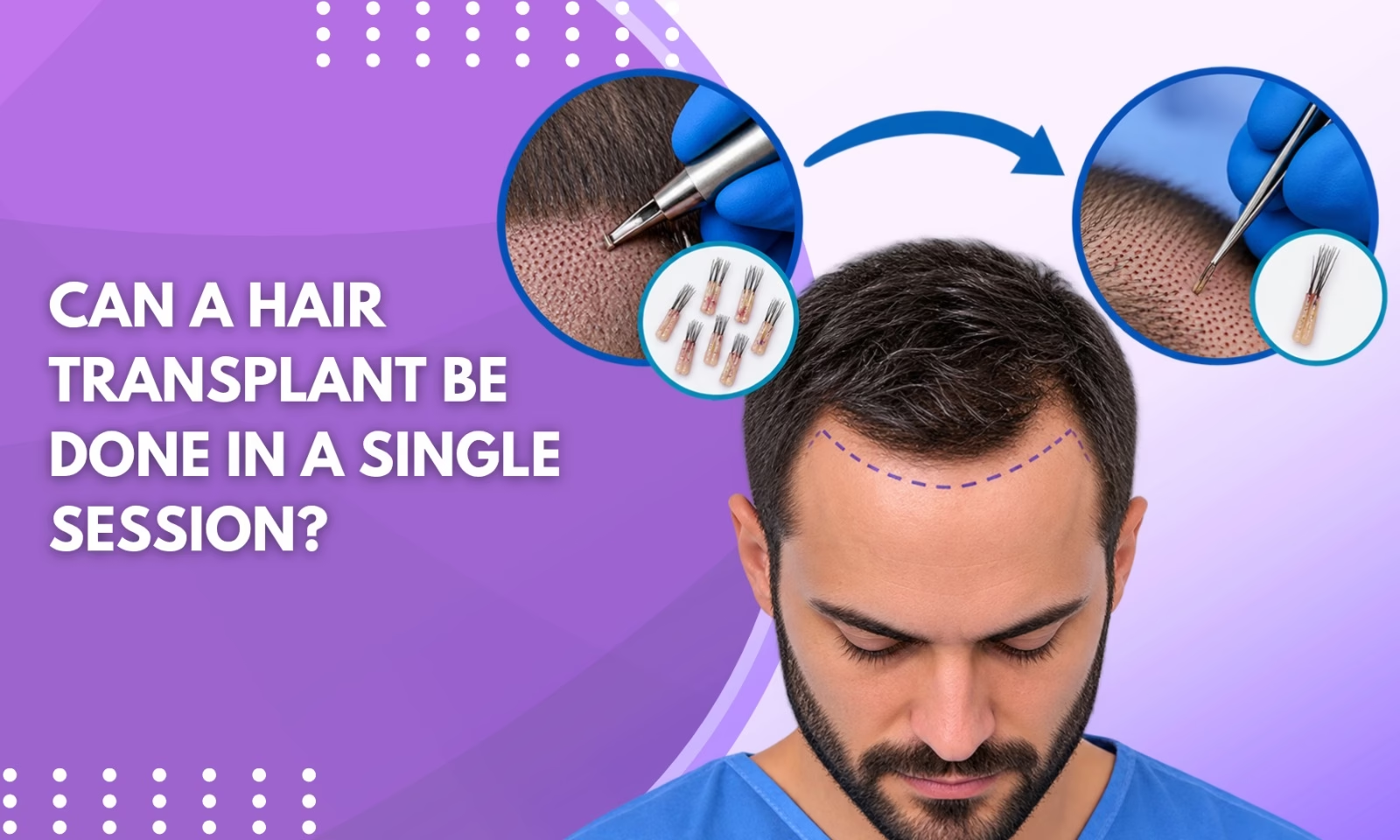
Often, yes. A hair graft transplant done in one sitting is common when the thinning area is small or moderate and the donor zone has enough hair to cover it. Bigger areas are less straightforward, and some of those plans end up divided over two or more visits.
According to Dr. Viral Desai, hair transplant surgeon in Mumbai, “Whether a single session is enough depends on two numbers: how many grafts the area needs and how many the donor zone can safely provide. When the donor zone covers the need, one session works. When it doesn’t, staging the work across sessions protects the donor area.”
Wondering if your hair loss can be treated in one session?
What Decides Whether One Sitting Is Enough?
Two figures matter here. One is the number of grafts the bald area needs. The other is how many the back and sides can safely spare.
Extent of hair loss: A receding hairline or thin crown often takes 1,000 to 2,500 grafts, which fits easily into a day. A scalp that’s bald across the top needs far more, and a single sitting may not stretch that far.
Donor supply: The back and sides hold a limited amount of permanent hair. Surgeons set a safe harvest limit, and one session can’t go past it.
Density goals: Wanting a dense finish takes more grafts than settling for lighter coverage. Two patients with the same bald patch can end up with quite different totals.
Hair characteristics: Thick, coarse hair gives more coverage per graft than fine hair, so someone with heavy strands may need fewer grafts to get the look they want.
A hair graft transplant plan starts with all four of these on the table. The session count is just what falls out of the math afterward.
How Many Grafts Can One Session Hold?
Most sessions stay under 3,000 grafts, though bigger plans do exist. Surgeons don’t all use the same labels, so take these numbers as ranges.
Standard sessions: Under 3,000 grafts in most cases. That’s enough for plenty of hairline and crown work in a single day.
Megasessions: Around 3,000 grafts and up, and some series have gone as high as 6,000. Expect 6 to 12 hours in the chair.
Giga sessions: Around 5,000 grafts or more, often split across two consecutive days. They’re uncommon and lean heavily on the donor area.
Survival at scale: Large sessions can still do well. In one study, 273 patients received 3,000 to 6,000 grafts each, and survival landed between 93.5% and 96.6%.
Wondering how a graft target actually gets set? Our guide on how many grafts a full hair transplant needs explains the Norwood stage, the size of the area, and how donor supply fits in.
Why Do Some Patients Need More Than One Session?
Staging can feel like settling for less. In practice it’s usually a way of looking after the donor area.
Limited donor supply: If the area needs more grafts than the donor zone can safely spare in one go, the harvesting gets spread across sessions.
Very large coverage areas: Loss that runs across the entire top of the scalp often takes two rounds to reach the density the patient wants.
Results still maturing: Transplanted hair needs many months to grow in, which is why a second round normally waits for the first to finish.
Ongoing hair loss: Transplanted hair stays where it was placed. The native hair around it can keep thinning, and a later session can deal with that when it shows up.
Our piece on getting a hair transplant twice explains when a second session is appropriate and what limits it.
Key Takeaways : One session works when the graft target is modest and the donor area can cover it. Most plans land under 3,000 grafts, and larger ones are possible but demanding. When the loss is advanced or donor supply is thin, staging is the usual route. It also shows how round one turned out before round two is planned.
Want a clearer picture of how many grafts your area would need?
Frequently Asked Questions
Can a hair transplant be done in one session?
Yes, for many patients. Small to moderate areas usually fit in one day.
How many grafts fit in one session?
Most stay under 3,000. Bigger sessions exist but aren’t common.
What makes a second session necessary?
A big treatment area, limited donor supply, or hair loss that keeps progressing.
How far apart should two sessions be?
Usually 12 to 18 months, once the first round has fully grown in.
References
- Li et al. — Clinical Experience on Follicular Unit Extraction Megasession for Severe Androgenetic Alopecia: https://onlinelibrary.wiley.com/doi/10.1111/jocd.13156
- Hair Transplantation Surgery: Its Current Status: https://www.ncbi.nlm.nih.gov/pmc/articles/PMC2956959/
Disclaimer: This article is for educational purposes only, not medical advice. Consult a surgeon before deciding on treatment.