

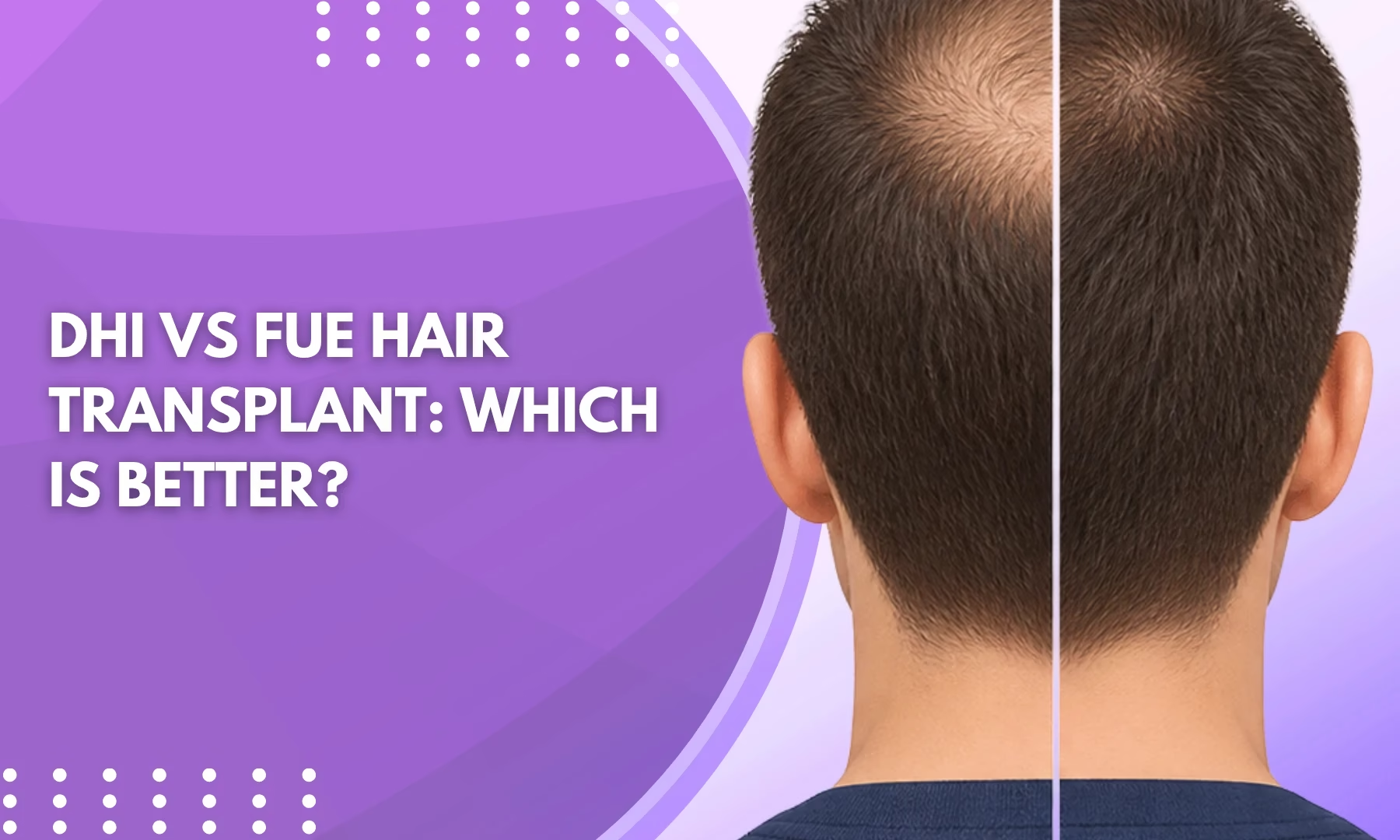
Neither DHI nor FUE wins outright. FUE covers large areas faster, while DHI offers more precision for dense, natural-looking hairline work. So the better choice comes down to what the case actually needs.
According to Dr. Viral Desai, dhi hair transplant surgeon in Mumbai, “Patients often want a simple answer, but it doesn’t work that way. Large area, FUE usually makes more sense. Dense, precisely angled hairline, DHI tends to deliver better results.”
Not sure which technique fits your hair loss pattern?
How Do DHI and FUE Actually Differ in Practice?
The core extraction process is nearly identical between the two. Where they diverge is in what happens next.
Implantation method: In FUE, the surgeon creates recipient sites first, then inserts grafts separately afterward. DHI combines both steps using the Choi Implanter Pen, placing each graft directly into the scalp in one motion.
Speed of coverage: FUE is generally faster for treating large areas, since site creation and graft placement can happen somewhat in parallel across a bigger surface. DHI’s one-by-one approach takes longer per graft.
Precision and control: DHI allows tighter control over the angle, depth, and direction of each graft, which matters most in visible areas like the hairline where natural-looking placement and density are important.
Shaving requirements: FUE typically requires shaving the recipient area beforehand. DHI may allow little or no shaving depending on the case.
A dhi hair transplant consultation is where donor supply, treatment area, and density goals get evaluated to determine which technique actually fits.
When Does DHI vs FUE Actually Matter for Your Results?
The comparison isn’t just theoretical, it shows up differently depending on what’s being treated.
Large bald areas: FUE tends to be the more practical choice here, since covering significant surface area efficiently matters more than micro-level precision on every single graft.
Hairline design: DHI often produces a more natural-looking hairline, since the angle and direction of each follicle can be controlled precisely as it’s implanted, mimicking how hair naturally grows in that zone.
Graft survival: DHI can reduce the time follicles spend outside the body between extraction and implantation, which may support slightly better graft survival in some cases.
Cost and time: FUE is generally quicker and less expensive per session, while DHI’s added precision typically comes with a longer procedure time and higher cost.
Our detailed comparison of NHDT vs FUT vs FUE covers how each of these approaches handles graft placement, recovery, and results across the board.
Why Choose Dr. Viral Desai for DHI or FUE Hair Transplant?
Dr. Viral Desai brings over 20 years of experience in hair restoration, with more than 10,000 successful hair transplant procedures performed across DHI, FUE, and other techniques.
Technique selection here starts with an honest assessment of what the case actually needs, not a default preference for one method over another. Call +91 98338 77001 to book your consultation.
Ready to find out whether DHI or FUE is the better fit for you?
Frequently Asked Questions
Is DHI always better than FUE?
No, FUE covers large areas faster, DHI offers more hairline precision.
Which technique gives more natural results?
DHI often does for hairlines, due to precise angle and depth control.
Is DHI more expensive than FUE?
Usually yes, given the added time and precision the technique requires.
Can DHI and FUE be combined in one session?
Yes, some surgeons use FUE for coverage and DHI for hairline refinement.
Disclaimer: This article is for educational purposes only. Suitability for DHI or FUE depends on individual scalp and donor characteristics, so an in-person evaluation is necessary before choosing a technique.