
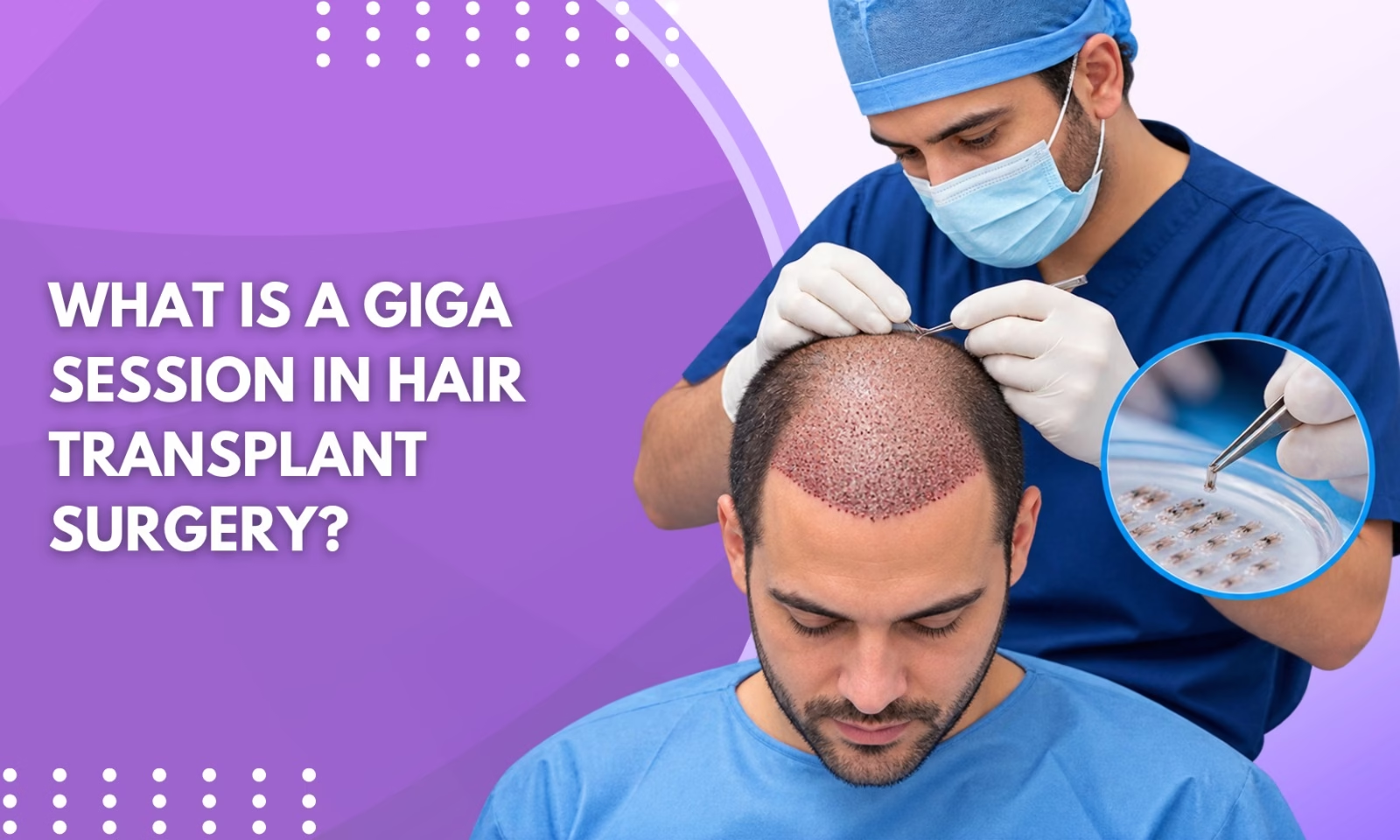
A giga session (sometimes called a giga hair transplant) sits at the very top of the size scale in hair transplant surgery. It means 5,000 grafts or more, often over 10,000 individual hairs, placed in one very long sitting or across two days in a row. Most patients never come close to that number.
According to Dr. Viral Desai, hair transplant surgeon in Mumbai, “A giga session is defined by graft count, but the donor area decides whether it’s possible. The real question isn’t how many grafts we’d like to place. It’s how many the donor zone can safely provide without looking thinned out.”
Unsure whether a session this size applies to your hair loss?
Is a Giga Session Just a Bigger Mega Session?
Surgeons don’t all draw the line in the same place. Some papers even call 6,000 grafts a megasession, so treat these figures as rough ranges.
Graft count: Under 3,000 is a typical session. Roughly 3,000 to 5,000 sits in megasession territory, and giga starts near 5,000 with some cases reaching 8,000 or more.
Time frame: A megasession alone can take 6 to 12 hours, which is why giga cases are often spread over two consecutive days.
Donor sources: Scalp hair supplies most of the grafts, though some plans add beard or body hair when the scalp alone can’t cover the target.
Typical candidate: This usually means advanced hair loss and a dense donor area, since a thinner one can’t safely provide this many grafts.
Planning a giga hair transplant starts with two measurements: donor density and how much coverage the patient actually needs. Only then does a graft target make sense.
What Happens Before and During a Giga Session?
There’s little room to improvise on the day. The planning does most of the work.
Donor assessment: Density gets measured first. The safe harvest limit comes out of that number, and the graft target has to fit inside it.
Extraction method: A strip (FUT) can yield a lot of grafts in one go, while FUE spreads the harvesting across the donor area. Pairing the two is one way to reach big numbers without leaning too hard on either.
Graft handling: Harvested grafts are kept in a chilled holding solution, and the time matters. The more grafts in play, the more carefully the team has to pace extraction against implantation.
Team and pacing: A megasession alone can take 6 to 12 hours. Giga cases need a practiced team and a schedule built to manage the extended procedure.
If you’re curious how a graft number gets decided in the first place, our guide on how many grafts a full hair transplant needs covers the Norwood scale, area size, and donor supply.
What Are the Risks and Limits of a Giga Session?
A bigger session isn’t automatically a better one. Each extra graft draws on a supply that doesn’t refill.
Donor depletion: There’s only so much permanent donor hair to go around. Overharvest it and the back and sides can look sparse, with less left for any touch-up later.
Graft survival: Large sessions can still do well. A study of 273 patients getting 3,000 to 6,000 grafts each reported survival of 93.5% to 96.6%.
Long procedure time: Six to twelve hours is a long day in a chair. It wears on the patient and the team, and fatigue matters in work this precise.
Staging as an option: Two or more sessions spaced months apart can be the better route for many patients. The donor area has time to heal, and the first round’s results are visible before the next decision.
Our piece on getting a hair transplant twice explains how repeat procedures work and what limits a second round.
Key Takeaways : A giga session is a very large hair transplant of about 5,000 grafts or more, done in one long sitting or across two days. It fits advanced hair loss with a strong donor area, and the donor supply (not the graft target) sets the limit. With careful handling graft survival rates can remain high. Even so, many patients are better served by splitting the procedure into stages.
Want to know how many grafts your donor area can safely provide?
Frequently Asked Questions
How big is a giga session?
Roughly 5,000 grafts at minimum, and some plans exceed 8,000.
What’s the difference between mega and giga sessions?
Mega sessions start near 3,000 grafts. Giga sessions begin around 5,000.
Who is a candidate for a giga session?
Patients with advanced hair loss and a dense, healthy donor area.
Can a giga session damage the donor area?
Yes. Overharvesting can leave it visibly thin, so extraction limits matter.
References
- Li et al. — Clinical Experience on Follicular Unit Extraction Megasession for Severe Androgenetic Alopecia: https://onlinelibrary.wiley.com/doi/10.1111/jocd.13156
- Hair Transplantation Surgery: Its Current Status: https://www.ncbi.nlm.nih.gov/pmc/articles/PMC2956959/
Disclaimer : This article is for educational purposes only, not medical advice. Consult a surgeon before deciding on treatment.