

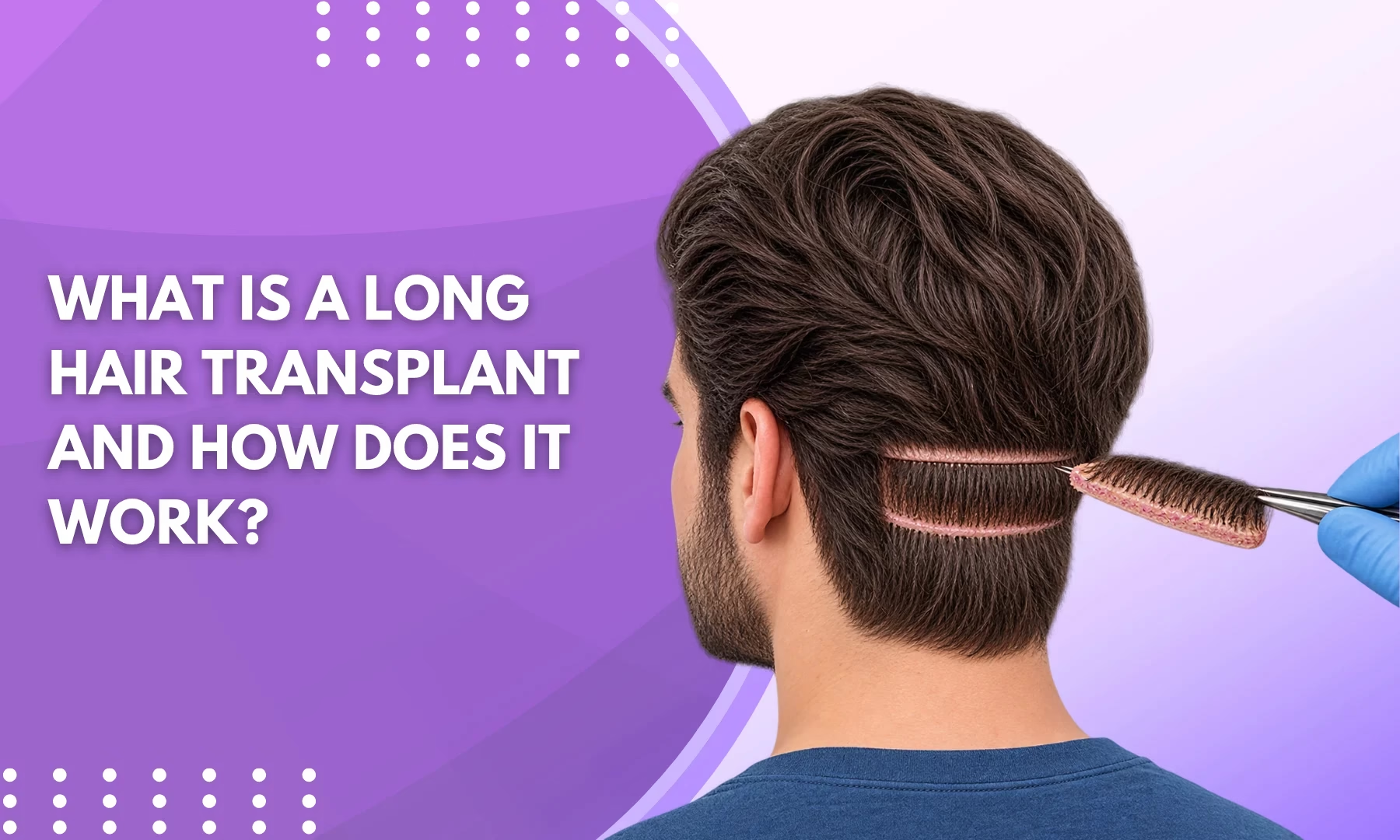
A long hair transplant, also called Long Hair FUE or no-shave FUE, is an advanced variation of standard FUE where follicles are extracted and implanted with their full hair shaft intact, so there’s no need to shave the head. Each graft keeps its visible length throughout, giving patients a near-immediate preview of their results.
According to Dr. Viral Desai, hair transplant surgeon in Mumbai, “Patients care a lot about discretion, especially those who can’t take a week off to hide a shaved head. Long hair FUE solves that problem directly. It’s technically more demanding since the surgeon has to work around full-length hair during extraction, but the payoff is a transplant nobody has to know just happened.”
Curious whether a long hair transplant fits your situation?
How Does the Long Hair Transplant Procedure Actually Work?
The core steps mirror standard FUE, but the no-shave element changes how each stage gets handled.
Pre-trimming or direct extraction: Depending on the specific technique, hair in the donor area is either lightly pre-trimmed in thin strips or left fully untouched, with follicles extracted directly through surrounding long hair.
Careful follicle extraction: Specialized punches, often recess-tipped, extract follicles while minimizing damage to the long hair shaft, since standard punches can snag or break hair during the process.
Donor camouflage throughout: Because extraction happens across untrimmed hair, the donor area stays visually camouflaged by surrounding strands even as grafts are removed.
Implantation with visible length: Grafts go into the recipient area complete with their full-length hair, giving both the surgeon and patient an immediate visual read on density and direction before healing even begins.
A long hair transplant consultation is where candidacy for this approach actually gets assessed, since not every donor area or hair type suits the technique equally well.
What Are the Trade-Offs of a Long Hair Transplant?
Long hair FUE isn’t simply a cosmetic upgrade to standard FUE. It comes with real technical trade-offs worth understanding.
Higher graft yield in some studies: Research comparing techniques found long hair FUE extracted roughly 20% more usable grafts from the donor zone compared to traditional shaved methods in the same session.
Slightly higher transection risk: The same long hair shafts that make extraction more discreet also interfere with visualization, which has been linked to a modestly higher partial transection rate in several studies.
A slower, more demanding procedure: Long hair FUE generally takes close to twice as long as shaved FUE, since surgeons work more carefully around intact hair throughout extraction and implantation.
Immediate aesthetic feedback: Because grafts retain visible length, both density and hair direction can be evaluated on the spot, something shaved FUE simply can’t offer until regrowth months later.
Our comparison of NHDT vs FUT vs FUE places long hair and no-shave approaches in context alongside the other major hair transplant techniques.
Why Choose Dr. Viral Desai for a Long Hair Transplant?
Dr. Viral Desai brings over 20 years of experience in hair restoration with more than 10,000 successful hair transplant procedures performed across techniques that all depend on precise, no-shave extraction methods like long hair FUE.
Every case starts with a detailed look at hair texture, curl pattern, and donor density rather than assuming a patient’s hair automatically suits a no-shave approach. Call +91 98338 77001 to book your consultation.
Wondering if a long hair transplant suits your hair type and goals?
Frequently Asked Questions
Does a long hair transplant require shaving the head?
No, that’s the main point, hair stays at its natural length throughout.
Does a long hair transplant take longer than standard FUE?
Yes, it typically takes close to twice as long to perform.
Can I see results immediately after a long hair transplant?
Yes, since grafts retain visible length, giving an instant aesthetic preview.
Is long hair FUE riskier than standard FUE?
It carries a slightly higher transection risk, though graft survival stays comparable.
Disclaimer: This blog is for educational purposes only, not medical advice. Consult a surgeon before deciding on treatment.