
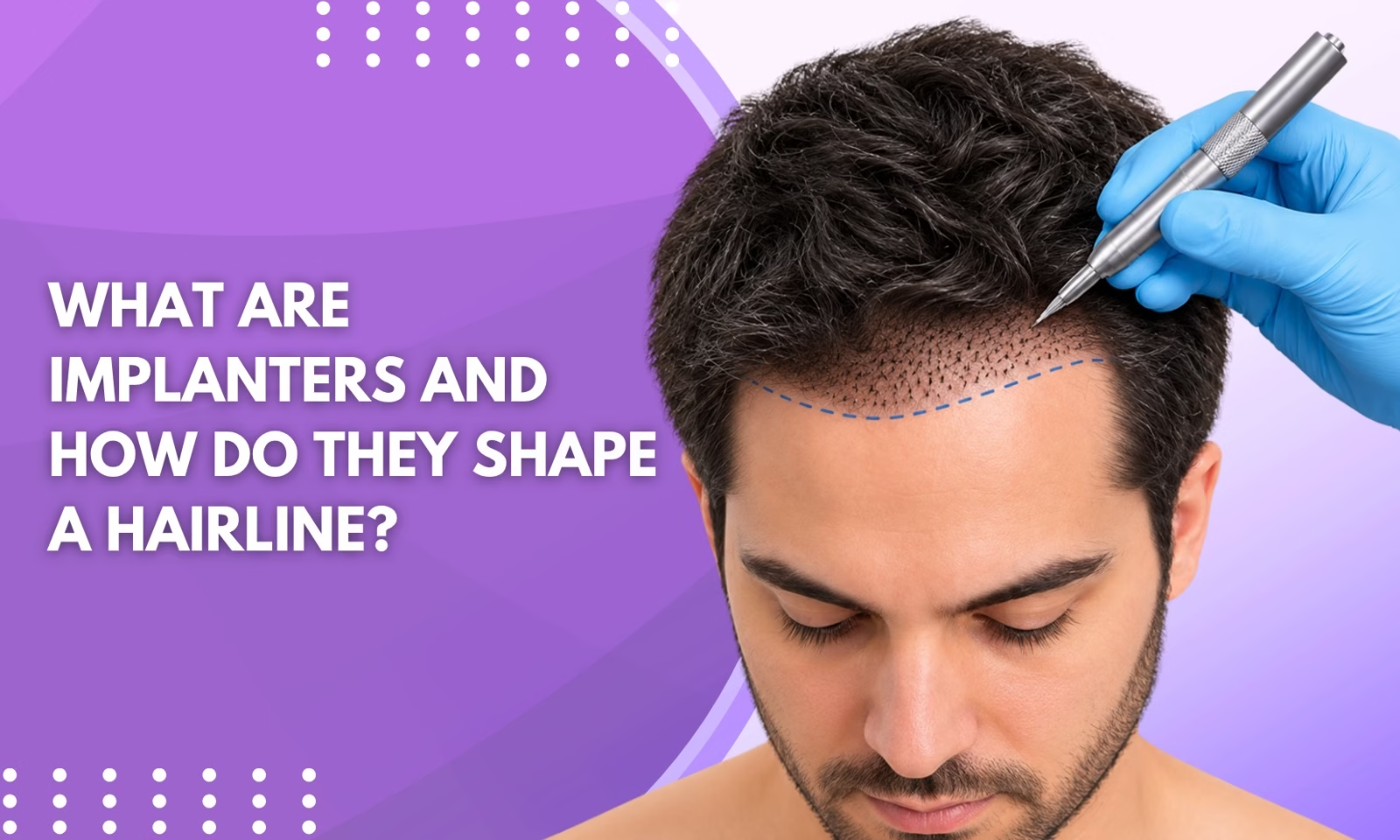
Implanters, sometimes called implanter pens or Choi implanters, are small tools surgeons use in a hair transplant to put follicles directly into the scalp. The older route takes two steps: make a slit, then place each graft with forceps. An implanter does both at once.
According to Dr. Viral Desai, hair transplant surgeon in Mumbai, “Every graft has three variables that decide how natural it looks: angle, direction, and depth. Implanters let the surgeon set all three in the same motion that places the graft. That matters most at the front hairline, where the margin for error is smallest.”
Unsure whether implanters would suit your hairline?
What Are Implanters and How Do They Work?
Picture a pen with a hollow needle where the nib would be and a plunger at the back. One pass cuts the site and releases the graft.
Loading: The follicle goes into the hollow needle before it ever touches the scalp. The graft must fit the tip properly to avoid bending or crushing during loading and placement.
Passing: Many teams have an assistant hand each loaded implanter to the surgeon, so the surgeon can focus on placement.
Single-motion placement: The sharp tip punctures the skin and the plunger releases the graft in the same movement. That’s the real difference from forceps work, where cutting and placing are separate steps.
Tip sizing: Tips come in several diameters. Matching one to the graft protects the follicle.
It isn’t a one-size tool. Whether hair transplant make sense for a patient depends on donor density, hair type, and the area being treated.
How Do Implanters Help Shape a Natural Hairline?
A natural hairline is built from small details repeated thousands of times. Implanters give the surgeon a say in every one of them.
Angle: Along the front hairline hair leaves the scalp at roughly 10 to 20 degrees. In the mid-scalp it’s closer to 30 to 40. Because cutting and placing happen together, the surgeon can adjust the angle graft by graft, including for the curl of the hair.
Direction: Gradual shifts in direction copy how native hair flows. Abrupt changes can pop grafts out or injure the ones nearby.
Depth: A graft must be placed at an appropriate depth to avoid sitting too high or too deep. Depth control is generally seen as the key factor for graft survival.
Density: Done correctly, the technique can place more than 50 to 60 grafts per square centimeter without popping or hurting survival. And that kind of density is what a fuller front edge needs.
Our overview of the latest innovations in hair transplant technology shows where implanter-based approaches like DHI fit among newer tools. It also covers graft preservation and other advances that work alongside them.
What Are the Limitations of Implanters?
Implanters bring real advantages. They still aren’t the right tool for every case.
Technique sensitivity: Most surgeons pick the method up fairly quickly. But consistent results still come from experience, especially with angle, depth, and loading.
Bleeding control: Cutting and placing happen at the same moment, so the technique is more prone to bleeding. Managing it is part of doing the procedure well.
Graft fit: The tip has to match the graft. Too small, and the follicle can get crushed or bent, which is why hair texture and graft size both affect the outcome.
Team coordination: Loading, passing, and implanting form one continuous sequence, and the pace depends on a trained team working in sync.
For a wider view, our comparison of NHDT vs FUT vs FUE lays out how the main hair transplant techniques differ on results and recovery.
Key Takeaways : An implanter turns two steps into one, which gives the surgeon direct control over angle, direction, and depth. These three factors decide whether a hairline looks natural. The tool works best with the right tip size, good bleeding control, and an experienced team. And whether it fits a given case depends on hair type, donor supply, and the area being treated.
Wondering if a long hair transplant suits your hair type and goals?
Frequently Asked Questions
What is a hair implanter?
A pen-shaped tool that creates the site and places the graft in a coordinated movement.
How do implanters differ from forceps placement?
Forceps need a slit made first. Implanters cut and place at once.
Can implanters control hair angle and direction?
Yes. The surgeon can adjust both for each graft as it goes in.
Do implanters suit every patient?
Not always. Hair type, graft size, and treatment area all play a part.
References
- Park JH, Ho YH, Manonukul K. — A Practical Guide to Hair Graft Placement Using the Sharp Implanter Method: https://www.tandfonline.com/doi/full/10.2147/CCID.S411488
- Sethi P, Bansal A. — Direct Hair Transplantation: A Modified Follicular Unit Extraction Technique: https://pmc.ncbi.nlm.nih.gov/articles/PMC3764754/
Disclaimer: This article is for educational purposes only, not medical advice. Consult a surgeon before deciding on treatment.